

1266. Minimum Time Visiting All Points
Description
On a 2D plane, there are n points with integer coordinates points[i] = [xi, yi]. Return the minimum time in seconds to visit all the points in the order given by points.
You can move according to these rules:
- In
1second, you can either:- move vertically by one unit,
- move horizontally by one unit, or
- move diagonally
sqrt(2)units (in other words, move one unit vertically then one unit horizontally in1second).
- You have to visit the points in the same order as they appear in the array.
- You are allowed to pass through points that appear later in the order, but these do not count as visits.
Example 1:
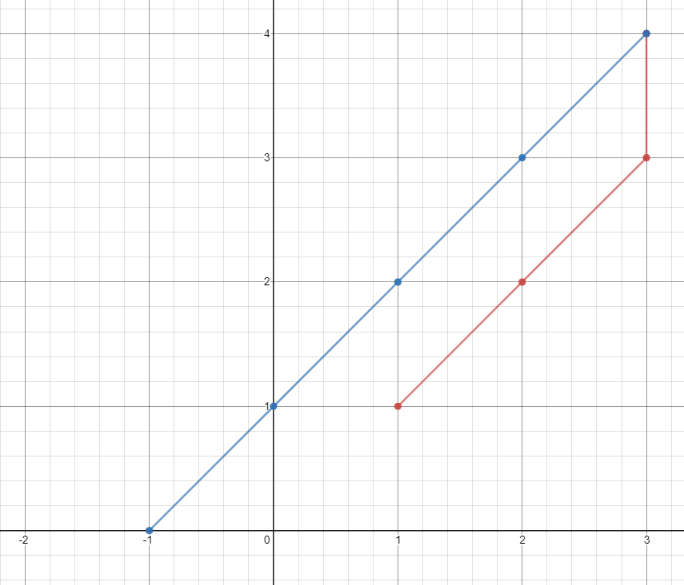
- Input: points = [[1,1],[3,4],[-1,0]]
- Output: 7
- Explanation:
One optimal path is [1,1] -> [2,2] -> [3,3] -> [3,4] -> [2,3] -> [1,2] -> [0,1] -> [-1,0]
Time from [1,1] to [3,4] = 3 seconds
Time from [3,4] to [-1,0] = 4 seconds
Total time = 7 seconds
Example 2:
- Input: points = [[3,2],[-2,2]]
- Output: 5
Constraints:
- points.length == n
- 1 <= n <= 100
- points[i].length == 2
- -1000 <= points[i][0], points[i][1] <= 1000
💡 Hint 1:
To walk from point A to point B there will be an optimal strategy to walk ?
💡 Hint 2:
Advance in diagonal as possible then after that go in straight line.
💡 Hint 3:
Repeat the process until visiting all the points.
Submitted Code
class Solution:
    def minTimeToVisitAllPoints(self, points: List[List[int]]) -> int:
        time = 0

        for i in range(len(points)-1):
            dx = abs(points[i+1][0] - points[i][0])
            dy = abs(points[i+1][1] - points[i][1])
            time += max(dx, dy)

        return time
Runtime: 0 ms | Beats 100.00%
Memory: 19.24 MB | Beats 90.20%
dx, dy가 둘 다 남아있는 동안에는 대각선으로 min(dx, dy)번 이동 가능하고 dx, dy가 동시에 1씩 감소된다. 한쪽이 0이 되면 남은 쪽으로 |dx - dy|번 직선 이동하면 된다. 대각선 거리과 직선 거리를 모두 합하면 결국 max(dx, dy)가 된다.
Other Solutions
1st
from itertools import pairwise

class Solution:
    def minTimeToVisitAllPoints(self, points: List[List[int]]) -> int:
        return sum(max(abs(P[0]-Q[0]), abs(P[1]-Q[1])) for P, Q in pairwise(points))
time complexity: 𝑂(𝑛)
space complexity: 𝑂(1)
Python 3.10부터 itertools에 추가된 pairwise() 함수로 연속된 원수의 앞과 뒤를 쌍으로 묶을 수 있다. 이하 버전에서는 zip()을 사용하면 된다.
(e.g. [1, 2, 3, 4] → (1, 2), (2, 3), (3, 4))

Leave a comment