

867. Transpose Matrix
Description
Given a 2D integer array matrix, return the transpose of matrix.
The transpose of a matrix is the matrix flipped over its main diagonal, switching the matrix’s row and column indices.
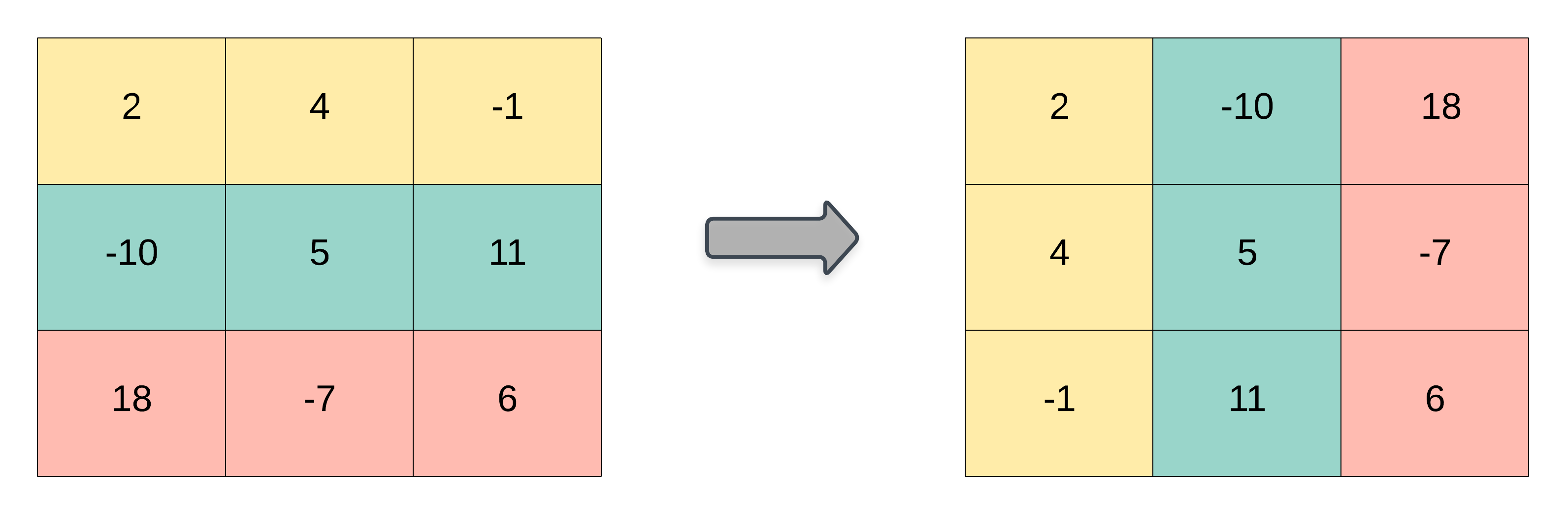
Example 1:
- Input: matrix = [[1,2,3],[4,5,6],[7,8,9]]
- Output: [[1,4,7],[2,5,8],[3,6,9]]
Example 2:
- Input: matrix = [[1,2,3],[4,5,6]]
- Output: [[1,4],[2,5],[3,6]]
Constraints:
- m == matrix.length
- n == matrix[i].length
- 1 <= m, n <= 1000
- 1 <= m * n <= 105
- -109 <= matrix[i][j] <= 109
💡 Hint 1:
We don't need any special algorithms to do this. You just need to know what the transpose of a matrix looks like. Rows become columns and vice versa!
Submitted Code
class Solution(object):
    def transpose(self, matrix):
        """
        :type matrix: List[List[int]]
        :rtype: List[List[int]]
        """
        rows, cols = len(matrix), len(matrix[0])
        result = [[0] * rows for _ in range(cols)]

        for r in range(rows):
            for c in range(cols):
                result[c][r] = matrix[r][c]

        return result
Runtime: 0 ms | Beats 100.00%
Memory: 13.06 MB | Beats 37.39%
전치 행렬을 새로 생성한 후, 행과 열의 인덱스를 변경한 위치에 값을 넣어주는 방법이 가장 많이 쓰이는 것 같다.
Other Solutions
1st
class Solution:
    def transpose(self, matrix: List[List[int]]) -> List[List[int]]:
        res = []

        for c in range(len(matrix[0])):
            temp = []

            for r in range(len(matrix)):
                temp.append(matrix[r][c])

            res.append(temp)

        return res
time complexity: 𝑂(𝑚*𝑛)
space complexity: 𝑂(𝑚*𝑛)
미리 모든 위치를 만들어놓지 않고 한 행씩 완성해나가는 방법도 있다.

Leave a comment