

872. Leaf-Similar Trees
Description
Consider all the leaves of a binary tree, from left to right order, the values of those leaves form a leaf value sequence.
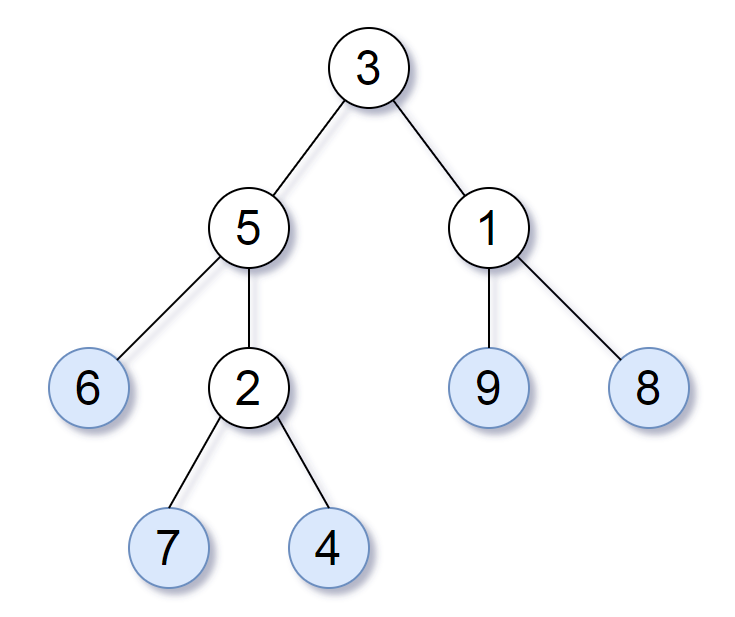
For example, in the given tree above, the leaf value sequence is (6, 7, 4, 9, 8).
Two binary trees are considered leaf-similar if their leaf value sequence is the same.
Return true if and only if the two given trees with head nodes root1 and root2 are leaf-similar.
Example 1:
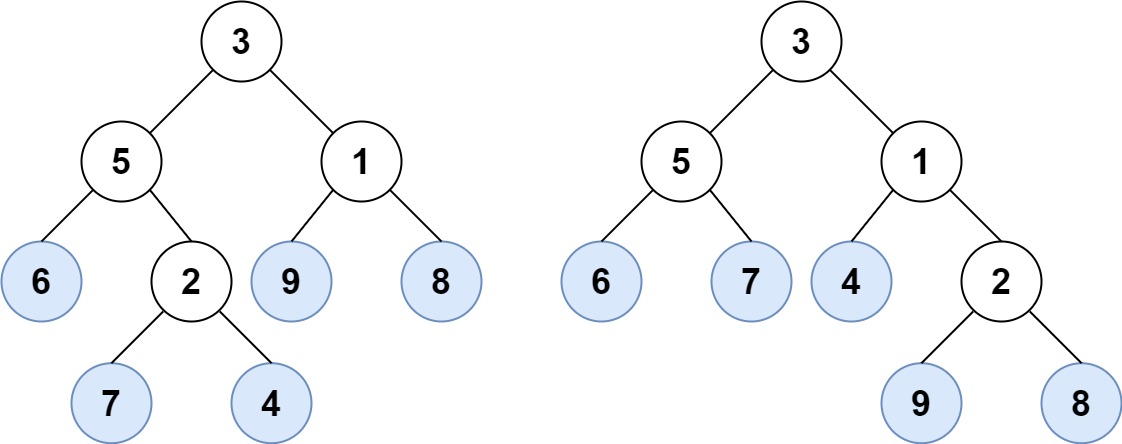
- Input: root1 = [3,5,1,6,2,9,8,null,null,7,4], root2 = [3,5,1,6,7,4,2,null,null,null,null,null,null,9,8]
- Output: true
Example 2:
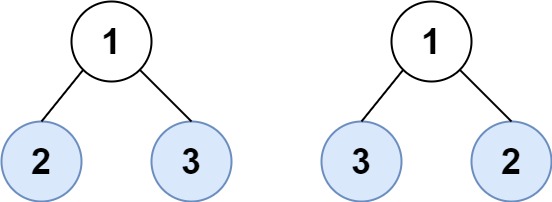
- Input: root1 = [1,2,3], root2 = [1,3,2]
- Output: false
Constraints:
- The number of nodes in each tree will be in the range
[1, 200]. - Both of the given trees will have values in the range
[0, 200].
Submitted Code
# Definition for a binary tree node.
# class TreeNode(object):
#     def __init__(self, val=0, left=None, right=None):
#         self.val = val
#         self.left = left
#         self.right = right

class Solution(object):
    def leafSimilar(self, root1, root2):
        """
        :type root1: Optional[TreeNode]
        :type root2: Optional[TreeNode]
        :rtype: bool
        """
        def find_leaf(node, leaf_values):
            if not node.left and not node.right:    # 잎노드이면 리스트에 값 추가
                leaf_values.append(node.val)

            if node.left:
                find_leaf(node.left, leaf_values)
            if node.right:
                find_leaf(node.right, leaf_values)

        root1_leaf = []
        root2_leaf = []

        find_leaf(root1, root1_leaf)
        find_leaf(root2, root2_leaf)

        return root1_leaf == root2_leaf
Runtime: 0 ms | Beats 100.00%
Memory: 12.57 MB | Beats 69.57%
DFS로 잎 노드들을 왼쪽에서 오른쪽 순서로 수집한 뒤, 두 리스트를 비교했다.
Other Solutions
1st
class Solution:
    def leafSimilar(self, root1: Optional[TreeNode], root2: Optional[TreeNode]) -> bool:
        def collect_leaf_values(root, leaf_values):
            if not root:
                return
            if not root.left and not root.right:
                leaf_values.append(root.val)
            collect_leaf_values(root.left, leaf_values)
            collect_leaf_values(root.right, leaf_values)

        leaf_values1 = []
        leaf_values2 = []

        collect_leaf_values(root1, leaf_values1)
        collect_leaf_values(root2, leaf_values2)

        return leaf_values1 == leaf_values2
time complexity: 𝑂(𝑛)
space complexity: 𝑂(ℎ1+ℎ2)
재귀 종료 조건을 if not node: return으로 명시하는 것이 더 깔끔한 것 같다.
2nd
    def leafSimilar(self, root1, root2):
        def dfs(node):
            if not node: return
            if not node.left and not node.right: yield node.val
            for i in dfs(node.left): yield i    # == yield from dfs(node.left)
            for i in dfs(node.right): yield i   # == yield from dfs(node.right)
        return all(a == b for a, b in itertools.izip_longest(dfs(root1), dfs(root2)))
제너레이터를 사용하면 잎 노드를 만날 때마다 값을 하나씩 내놓기 때문에 리스트를 만들지 않아도 된다는 장점이 있다.
itertools 모듈의 izip_longest()는 dfs(root1)과 dfs(root2)를 순서대로 실행하여 각각에서 잎의 값 하나씩을 가져온 후, 두 값을 묶어주는 함수다. zip()과 비슷하지만 차이점은 두 시퀀스 길이가 다를 경우 짧은 쪽을 None으로 채워서 끝까지 비교할 수 있도록 해준다는 것이다.

Leave a comment