

2. Add Two Numbers
Description
You are given two non-empty linked lists representing two non-negative integers. The digits are stored in reverse order, and each of their nodes contains a single digit. Add the two numbers and return the sum as a linked list.
You may assume the two numbers do not contain any leading zero, except the number 0 itself.
Example 1:
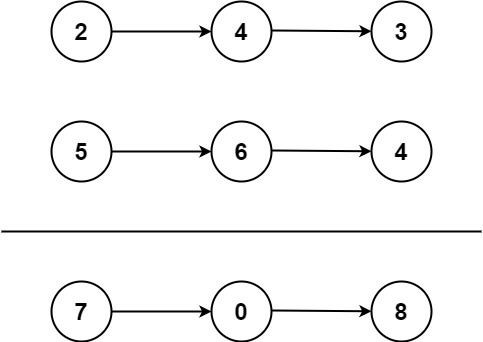
- Input: l1 = [2,4,3], l2 = [5,6,4]
- Output: [7,0,8]
- Explanation: 342 + 465 = 807.
Example 2:
- Input: l1 = [0], l2 = [0]
- Output: [0]
Example 3:
- Input: l1 = [9,9,9,9,9,9,9], l2 = [9,9,9,9]
- Output: [8,9,9,9,0,0,0,1]
Constraints:
- The number of nodes in each linked list is in the range
[1, 100]. - 0 <= Node.val <= 9
- It is guaranteed that the list represents a number that does not have leading zeros.
Submitted Code
# Definition for singly-linked list.
# class ListNode:
#     def __init__(self, val=0, next=None):
#         self.val = val
#         self.next = next

class Solution:
    def addTwoNumbers(self, l1: Optional[ListNode], l2: Optional[ListNode]) -> Optional[ListNode]:
        dummy = ListNode(0)     # 결과 연결리스트 노드 생성(더미 노드로 시작)
        curr = dummy            # 현재 노드 위치
        carry = 0               # 올림수

        while l1 or l2 or carry:
            v1 = l1.val if l1 else 0
            v2 = l2.val if l2 else 0
            total = v1 + v2 + carry
            carry = total // 10

            curr.next = ListNode(total % 10)    # 다음 노드 생성
            curr = curr.next                    # 다음 노드로 이동

            if l1: l1 = l1.next
            if l2: l2 = l2.next

        return dummy.next
Runtime: 0 ms | Beats 100.00%
Memory: 19.42 MB | Beats 39.11%
새 연결 리스트를 만들어서 더한 값을 저장하는 방법을 사용했다. 연결 리스트는 head를 유지해야 하기 때문에 더미 노드로 시작점을 고정했다.
Other Solutions
1st
class Solution:
    def addTwoNumbers(self, l1: Optional[ListNode], l2: Optional[ListNode]) -> Optional[ListNode]:

        dummy = ListNode()
        res = dummy

        total = carry = 0

        while l1 or l2 or carry:
            total = carry

            if l1:
                total += l1.val
                l1 = l1.next
            if l2:
                total += l2.val
                l2 = l2.next

            num = total % 10
            carry = total // 10
            dummy.next = ListNode(num)
            dummy = dummy.next

        return res.next
time complexity: 𝑂(max(𝑚,𝑛))
space complexity: 𝑂(max(𝑚,𝑛))

Leave a comment