

54. Spiral Matrix
Description
Given an m x n matrix, return all elements of the matrix in spiral order.
Example 1:
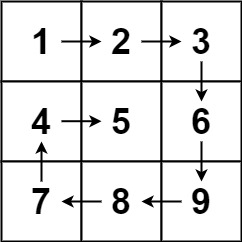 Input: matrix = [[1,2,3],[4,5,6],[7,8,9]]
Output: [1,2,3,6,9,8,7,4,5]
Input: matrix = [[1,2,3],[4,5,6],[7,8,9]]
Output: [1,2,3,6,9,8,7,4,5]
Example 2:
 Input: matrix = [[1,2,3,4],[5,6,7,8],[9,10,11,12]]
Output: [1,2,3,4,8,12,11,10,9,5,6,7]
Input: matrix = [[1,2,3,4],[5,6,7,8],[9,10,11,12]]
Output: [1,2,3,4,8,12,11,10,9,5,6,7]
Constraints:
m == matrix.length n == matrix[i].length 1 <= m, n <= 10 -100 <= matrix[i][j] <= 100
💡 Hint 1:
Well for some problems, the best way really is to come up with some algorithms for simulation. Basically, you need to simulate what the problem asks us to do.
💡 Hint 2:
We go boundary by boundary and move inwards. That is the essential operation. First row, last column, last row, first column, and then we move inwards by 1 and repeat. That's all. That is all the simulation that we need.
💡 Hint 3:
Think about when you want to switch the progress on one of the indexes. If you progress on i out of [i, j], you'll shift in the same column. Similarly, by changing values for j, you'd be shifting in the same row. Also, keep track of the end of a boundary so that you can move inwards and then keep repeating. It's always best to simulate edge cases like a single column or a single row to see if anything breaks or not.
Submitted Code
class Solution:
    def spiralOrder(self, matrix: List[List[int]]) -> List[int]:
        m, n = len(matrix), len(matrix[0])
        top, left, bottom, right = 0, 0, m-1, n-1
        res = []

        while left <= right and top <= bottom:
            for i in range(left, right+1):          # top행
                res.append(matrix[top][i])
            top += 1

            if top <= bottom:                       # right열
                for i in range(top, bottom+1):
                    res.append(matrix[i][right])
                right -= 1

            if top <= bottom:                       # bottom행
                for i in range(right, left-1, -1):
                    res.append(matrix[bottom][i])
                bottom -= 1

            if left <= right:                       # left열
                for i in range(bottom, top-1, -1):
                    res.append(matrix[i][left])
                left += 1

        return res
Runtime: 0 ms | Beats 100.00%
Memory: 19.30 MB | Beats 82.65%
한 줄을 완성한 다음 해당 행이나 열을 한 칸 안으로 옮기고 방향을 바꾸는 식으로 계속 반복했다. if문으로 중복 순회를 막는 것이 중요했다.
Other Solutions
1st
class Solution:
    def spiralOrder(self, matrix: List[List[int]]) -> List[int]:
        rows, cols = len(matrix), len(matrix[0])
        x, y, dx, dy = 0, 0, 1, 0
        res = []

        for _ in range(rows * cols):
            res.append(matrix[y][x])
            matrix[y][x] = "."

            if not 0 <= x + dx < cols or not 0 <= y + dy < rows or matrix[y+dy][x+dx] == ".":
                dx, dy = -dy, dx    # 방향 벡터를 90도 회전

            x += dx
            y += dy

        return res
time complexity: 𝑂(𝑚*𝑛)
space complexity: 𝑂(𝑚*𝑛)
이미 방문한 곳은 '.'으로 바꾸고 방향 벡터를 이용하여 이동하는 방법이다.
(dx,dy)	   (-dy,dx)
( 1, 0)	→   ( 0, 1) ↓
( 0, 1)	↓   (-1, 0) ←
(-1, 0)	←   (0, -1) ↑
(0, -1)	↑   ( 1, 0) →
2nd
class Solution:
    def spiralOrder(self, matrix):
        return matrix and [*matrix.pop(0)] + self.spiralOrder([*zip(*matrix)][::-1])
time complexity: 𝑂(𝑛2)
space complexity: 𝑂(𝑛2)
맨 위 행을 떼고, 나머지를 반시계 방향으로 90도 회전해서 재귀 호출하는 방법이다. [*zip(*matrix)](또는 list(zip(*matrix)))는 matrix를 한 행씩 풀어서 zip()으로 묶는 동작으로, 열 단위로 재구성된 결과가 된다. 전치(transpose)된 행렬을 거꾸로 뒤집으면 원래 matrix를 반시계 방향으로 90도 회전한 것과 같다.
matrix = [[1,2,3],[4,5,6],[7,8,9]]
[1,2,3]           [6,9]
[4,5,6]  [4,5,6]  [5,8]  [5,8]  [8,7]         [4]
[7,8,9]  [7,8,9]  [4,7]  [4,7]  [5,4]  [5,4]  [5]  [5]

[         1,2,3,          6,9,          8,7,        4, 5]
return [1,2,3,6,9,8,7,4,5]

Leave a comment