

109. Convert Sorted List to Binary Search Tree
Description
Given the head of a singly linked list where elements are sorted in ascending order, convert it to a height-balanced binary search tree.
Example 1:
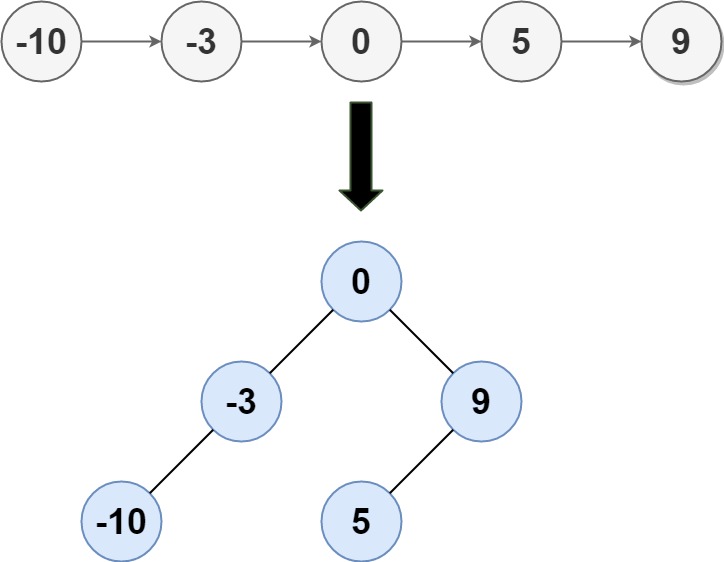
- Input: head = [-10,-3,0,5,9]
- Output: [0,-3,9,-10,null,5]
- Explanation: One possible answer is [0,-3,9,-10,null,5], which represents the shown height balanced BST.
Example 2:
- Input: head = []
- Output: []
Constraints:
- The number of nodes in head is in the range [0, 2 * 104].
- -105 <= Node.val <= 105
Submitted Code
# Definition for singly-linked list.
# class ListNode:
#     def __init__(self, val=0, next=None):
#         self.val = val
#         self.next = next

# Definition for a binary tree node.
# class TreeNode:
#     def __init__(self, val=0, left=None, right=None):
#         self.val = val
#         self.left = left
#         self.right = right

class Solution:
    def sortedListToBST(self, head: Optional[ListNode]) -> Optional[TreeNode]:
        nums = []
        while head:
            nums.append(head.val)
            head = head.next

        def build(left, right):
            if left > right:
                return None

            mid = (left + right) // 2

            root = TreeNode(nums[mid])
            root.left = build(left, mid-1)
            root.right = build(mid+1 , right)

            return root

        return build(0, len(nums)-1)
Runtime: 3 ms | Beats 98.53%
Memory: 24.07 MB | Beats 29.79%
연결 리스트를 먼저 순회해서 배열로 변환했다. 이미 오름차순으로 정렬된 배열이기 때문에 쉽게 BST로 변환할 수 있다.
Other Solutions
1st
class Solution:
    def sortedListToBST(self, head: Optional[ListNode]) -> Optional[TreeNode]:

        if not head:
            return None
        if not head.next:
            return TreeNode(head.val)

        slow = head
        slow_prev = slow    # used to break the connection for the root.left
        fast = head

        while fast and fast.next:
            slow_prev = slow
            slow = slow.next
            fast = fast.next.next

        if slow_prev:
            slow_prev.next = None

        root = TreeNode(slow.val)

        root.left = self.sortedListToBST(head)
        root.right = self.sortedListToBST(slow.next)

        return root
time complexity: 𝑂(𝑛log𝑛)
space complexity: 𝑂(log𝑛)
연결 리스트를 배열로 저장하고 싶지 않을 때 사용할 수 있는 방법이다. 다만 중간 노드를 찾기 위해 매번 slow/fast pointer로 순회하기 때문에 앞의 방법보다 시간 복잡도가 더 올라간다.

Leave a comment