

129. Sum Root to Leaf Numbers
Description
You are given the root of a binary tree containing digits from 0 to 9 only.
Each root-to-leaf path in the tree represents a number.
- For example, the root-to-leaf path
1 -> 2 -> 3represents the number123.
Return the total sum of all root-to-leaf numbers. Test cases are generated so that the answer will fit in a 32-bit integer.
A leaf node is a node with no children.
Example 1:
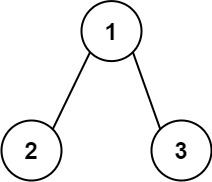
- Input: root = [1,2,3]
- Output: 25
- Explanation:
The root-to-leaf path 1->2 represents the number 12.
The root-to-leaf path 1->3 represents the number 13.
Therefore, sum = 12 + 13 = 25.
Example 2:
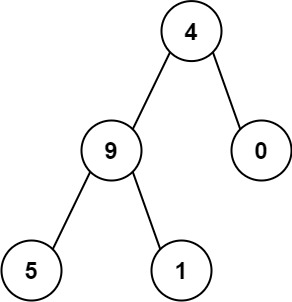
- Input: root = [4,9,0,5,1]
- Output: 1026
- Explanation:
The root-to-leaf path 4->9->5 represents the number 495.
The root-to-leaf path 4->9->1 represents the number 491.
The root-to-leaf path 4->0 represents the number 40.
Therefore, sum = 495 + 491 + 40 = 1026.
Constraints:
- The number of nodes in the tree is in the range
[1, 1000]. - 0 <= Node.val <= 9
- The depth of the tree will not exceed
10.
Submitted Code
# Definition for a binary tree node.
# class TreeNode:
#     def __init__(self, val=0, left=None, right=None):
#         self.val = val
#         self.left = left
#         self.right = right

class Solution:
    def sumNumbers(self, root: Optional[TreeNode]) -> int:
        def dfs(node, path):
            if not node:
                return

            path += (str(node.val))

            if not node.left and not node.right:
                path_sums.append(int(path))
            else:
                dfs(node.left, path)
                dfs(node.right, path)

        path_sums = []
        dfs(root, "")

        return sum(path_sums)
Runtime: 0 ms | Beats 100.00%
Memory: 19.26 MB | Beats 71.79%
깊이 우선 탐색으로 루트에서 잎 노드까지의 각 경로를 탐색했다.
Other Solutions
1st
class Solution:
    def sumNumbers(self, root: Optional[TreeNode]) -> int:
        def dfs(node, path):
            if not node:
                return 0
            path = path * 10 + node.val
            if not node.left and not node.right:
                return path
            return dfs(node.left, path) + dfs(node.right, path)

        return dfs(root, 0)
time complexity: 𝑂(𝑛)
space complexity: 𝑂(ℎ)
int에서 str, str에서 int 변환없이 푸는 방법이다.

Leave a comment