

86. Partition List
Description
Given the head of a linked list and a value x, partition it such that all nodes less than x come before nodes greater than or equal to x.
You should preserve the original relative order of the nodes in each of the two partitions.
Example 1:
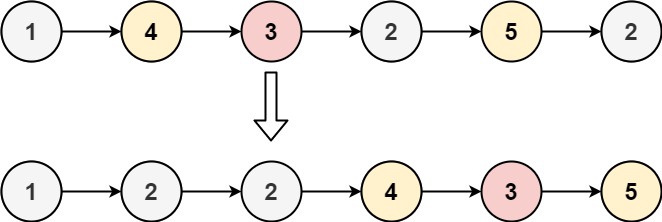
- Input: head = [1,4,3,2,5,2], x = 3
- Output: [1,2,2,4,3,5]
Example 2:
- Input: head = [2,1], x = 2
- Output: [1,2]
Constraints:
- The number of nodes in the list is in the range
[0, 200]. - -100 <= Node.val <= 100
- -200 <= x <= 200
Submitted Code
# Definition for singly-linked list.
# class ListNode:
#     def __init__(self, val=0, next=None):
#         self.val = val
#         self.next = next

class Solution:
    def partition(self, head: Optional[ListNode], x: int) -> Optional[ListNode]:
        small_dummy = ListNode(0)
        large_dummy = ListNode(0)

        small = small_dummy
        large = large_dummy

        while head:
            temp = head.next            # 다음 노드를 임시저장
            head.next = None            # 현재 노드-다음 노드 연결 끊기

            if head.val < x:            # 현재 노드 이동
                small.next = head
                small = small.next
            else:
                large.next = head
                large = large.next

            head = temp                 # 임시저장했던 다음 노드로 이동

        small.next = large_dummy.next   # small-large 연결

        return small_dummy.next
Runtime: 0 ms | Beats 100.00%
Memory: 19.46 MB | Beats 7.58%
x값 기준으로 small, large 리스트를 따로 분리한 후 현재 노드를 하나씩 떼어서 둘 중 하나에 붙이는 방법이다.
Other Solutions
1st
class Solution:
    def partition(self, head: Optional[ListNode], x: int) -> Optional[ListNode]:

        slist, blist = ListNode(), ListNode()
        small, big = slist, blist # dummy lists

        while head:
            if head.val < x:
                small.next = head
                small = small.next
            else:
                big.next = head
                big = big.next

            head = head.next

        small.next = blist.next
        big.next = None # prevent linked list circle

        return slist.next
time complexity: 𝑂(𝑛)
space complexity: 𝑂(1)

Leave a comment