

97. Interleaving String
Description
Given strings s1, s2, and s3, find whether s3 is formed by an interleaving of s1 and s2.
An interleaving of two strings s and t is a configuration where s and t are divided into n and m substrings respectively, such that:
- s = s1 + s2 + … + sn
- t = t1 + t2 + … + tm
- |n - m| <= 1
- The interleaving is s1 + t1 + s2 + t2 + s3 + t3 + … or t1 + s1 + t2 + s2 + t3 + s3 + …
Note: a + b is the concatenation of strings a and b.
Example 1:
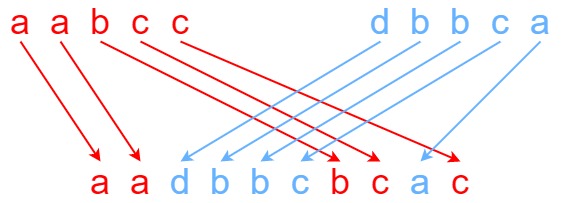
- Input: s1 = “aabcc”, s2 = “dbbca”, s3 = “aadbbcbcac”
- Output: true
- Explanation: One way to obtain s3 is:
Split s1 into s1 = “aa” + “bc” + “c”, and s2 into s2 = “dbbc” + “a”.
Interleaving the two splits, we get “aa” + “dbbc” + “bc” + “a” + “c” = “aadbbcbcac”.
Since s3 can be obtained by interleaving s1 and s2, we return true.
Example 2:
- Input: s1 = “aabcc”, s2 = “dbbca”, s3 = “aadbbbaccc”
- Output: false
- Explanation: Notice how it is impossible to interleave s2 with any other string to obtain s3.
Example 3:
- Input: s1 = “”, s2 = “”, s3 = “”
- Output: true
Constraints:
- 0 <= s1.length, s2.length <= 100
- 0 <= s3.length <= 200
s1,s2, ands3consist of lowercase English letters.
Follow up: Could you solve it using only O(s2.length) additional memory space?
Submitted Code
class Solution:
    def isInterleave(self, s1: str, s2: str, s3: str) -> bool:
        if len(s1) + len(s2) != len(s3):
            return False

        dp = [False] * (len(s2) + 1)
        dp[0] = True

        # 첫 번째 행 초기화(s2만 사용하는 경우)
        for j in range(1, len(s2) + 1):
            dp[j] = dp[j - 1] and s2[j - 1] == s3[j - 1]

        for i in range(1, len(s1) + 1):
            # 첫 번째 열 업데이트(s1만 사용하는 경우)
            dp[0] = dp[0] and s1[i - 1] == s3[i - 1]

            # 해당 행 나머지 칸 채우기
            for j in range(1, len(s2) + 1):
                use_s1 = dp[j] and s1[i - 1] == s3[i + j - 1]       # s1에서 문자 가져오는 경우
                use_s2 = dp[j - 1] and s2[j - 1] == s3[i + j - 1]   # s2에서 문자 가져오는 경우
                dp[j] = use_s1 or use_s2

        return dp[-1]
Runtime: 48 ms | Beats 74.22%
Memory: 19.24 MB | Beats 91.16%
s1 앞 i개와 s2 앞 j개로 s3 앞 i+j개를 만들 수 있는지 확인하기 위해 2차원 DP(dp[i][j])를 사용할 수 있다. Follow up 조건을 충족하려면 현재 행만 저장하는 1차원 DP(dp[j])로 공간을 최적화해야 한다.
s1 = “aabcc”
s2 = “dbbca”
s3 = “aadbbcbcac”
    ""  d   b   b   c   a
""  T   F   F   F   F   F  ← only s2
a   T   F   F   F   F   F
a   T   T   T   T   T   F
b   F   T   T   F   T   F
c   F   F   T   T   T   T
c   F   F   F   T   F   T
    ↑
    only s1
return True
Other Solutions
1st
class Solution:
    def isInterleave(self, s1: str, s2: str, s3: str) -> bool:
        m, n, l = len(s1), len(s2), len(s3)
        if m + n != l:
            return False

        dp = [[False] * (n + 1) for _ in range(m + 1)]
        dp[0][0] = True

        for i in range(1, m + 1):
            dp[i][0] = dp[i-1][0] and s1[i-1] == s3[i-1]

        for j in range(1, n + 1):
            dp[0][j] = dp[0][j-1] and s2[j-1] == s3[j-1]

        for i in range(1, m + 1):
            for j in range(1, n + 1):
                dp[i][j] = (dp[i-1][j] and s1[i-1] == s3[i+j-1]) or (dp[i][j-1] and s2[j-1] == s3[i+j-1])

        return dp[m][n]
time complexity: 𝑂(𝑛*𝑚)
space complexity: 𝑂(𝑛*𝑚)
2차원 DP

Leave a comment