

63. Unique Paths II
Description
You are given an m x n integer array grid. There is a robot initially located at the top-left corner (i.e., grid[0][0]). The robot tries to move to the bottom-right corner (i.e., grid[m - 1][n - 1]). The robot can only move either down or right at any point in time.
An obstacle and space are marked as 1 or 0 respectively in grid. A path that the robot takes cannot include any square that is an obstacle.
Return the number of possible unique paths that the robot can take to reach the bottom-right corner.
The testcases are generated so that the answer will be less than or equal to 2 * 109.
Example 1:
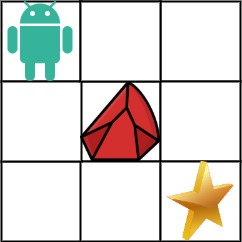
- Input: obstacleGrid = [[0,0,0],[0,1,0],[0,0,0]]
- Output: 2
- Explanation: There is one obstacle in the middle of the 3x3 grid above.
There are two ways to reach the bottom-right corner:- Right -> Right -> Down -> Down
- Down -> Down -> Right -> Right
Example 2:

- Input: obstacleGrid = [[0,1],[0,0]]
- Output: 1
Constraints:
- m == obstacleGrid.length
- n == obstacleGrid[i].length
- 1 <= m, n <= 100
- obstacleGrid[i][j] is
0or1.
💡 Hint 1:
Use dynamic programming since, from each cell, you can move to the right or down.
💡 Hint 2:
assume dp[i][j] is the number of unique paths to reach (i, j). dp[i][j] = dp[i][j -1] + dp[i - 1][j]. Be careful when you encounter an obstacle. set its value in dp to 0.
Submitted Code
class Solution:
    def uniquePathsWithObstacles(self, obstacleGrid: List[List[int]]) -> int:
        m, n = len(obstacleGrid), len(obstacleGrid[0])

        dp = [0] * n
        dp[0] = 1

        for i in range(m):
            for j in range(n):
                if obstacleGrid[i][j] == 1:
                    dp[j] = 0
                elif j > 0:
                    dp[j] += dp[j-1]        # 위에서 내려온 값 + 왼쪽 값

        return dp[-1]
Runtime: 0 ms | Beats 100.00%
Memory: 19.26 MB | Beats 91.65%
1차원 배열 하나로 위에서 내려온 값과 왼쪽의 값을 더해서 누적할 수 있다.
obstacleGrid = [[0,0,0],[0,1,0],[0,0,0]]
i   obstacleGrid   dp
                   [1, 0, 0]
0   [0, 0, 0]      [1, 1, 1]
1   [0, 1, 0]      [1, 0, 1]
2   [0, 0, 0]      [1, 1, 2]
return 2
Other Solutions
1st
class Solution:
    def uniquePathsWithObstacles(self, grid: List[List[int]]) -> int:
        m = len(grid)
        n = len(grid[0])

        # If start or end is blocked
        if grid[0][0] == 1 or grid[m - 1][n - 1] == 1:
            return 0

        # Initialize start
        grid[0][0] = 1

        # Initialize first row
        for i in range(1, n):
            if grid[0][i] == 0 and grid[0][i - 1] == 1:
                grid[0][i] = 1
            else:
                grid[0][i] = 0

        # Initialize first column
        for j in range(1, m):
            if grid[j][0] == 0 and grid[j - 1][0] == 1:
                grid[j][0] = 1
            else:
                grid[j][0] = 0

        # Fill remaining cells
        for i in range(1, m):
            for j in range(1, n):
                if grid[i][j] == 1:
                    grid[i][j] = 0
                else:
                    grid[i][j] = grid[i - 1][j] + grid[i][j - 1]

        return grid[m - 1][n - 1]
time complexity: 𝑂(𝑚*𝑛)
space complexity: 𝑂(1)

Leave a comment